Why enterprises are hesitant to work with vibe-coding platforms
January 30, 2026
5
minute read

Tomas Halgas
Founder & CEO
Vibe-coding platforms become messy and expensive in a very specific place: the backend.
Not because generating CRUD is hard. That part works. The problem appears when users try to ship something that has to survive reality. At that point, platforms run into a widening gap between software that works once, software that keeps working, and software that someone is willing to trust.
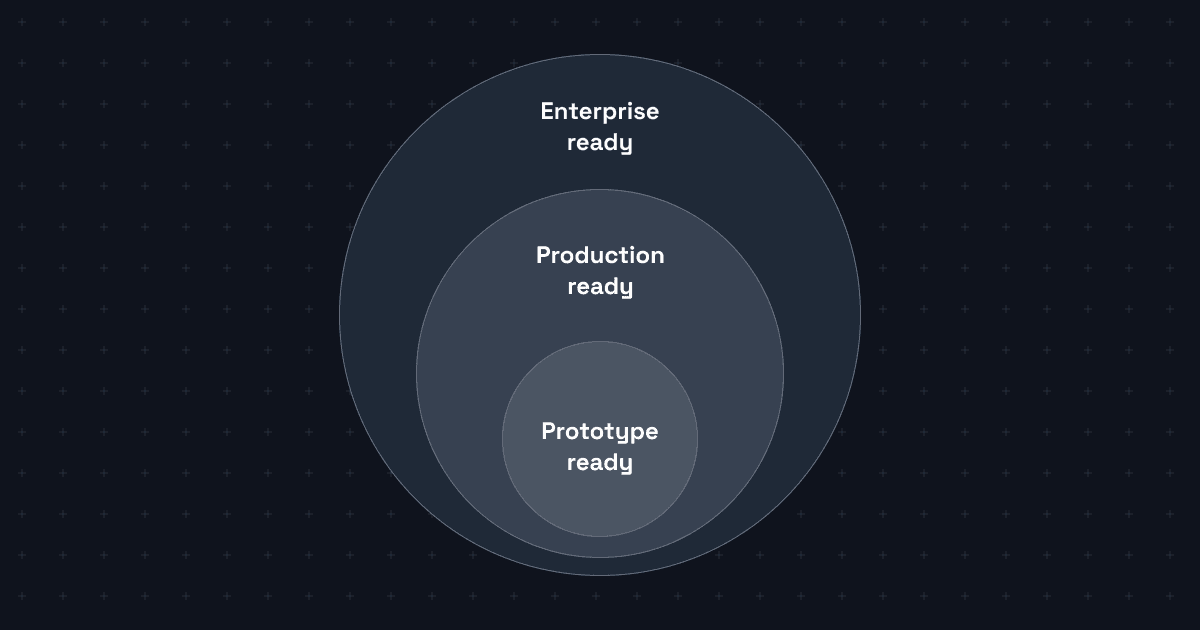
This post is about that gap, and why it exists. Not in terms of missing features, but in terms of what enterprise-ready actually means for software generated by a vibe-coding platform.
Enterprises don’t buy “works”
Vibe-coding platforms are optimized for speed and flow. Intent turns into an app, feedback is immediate, and progress feels tangible.
Enterprises are optimized for the opposite. They care about predictability, ownership, controlled change, and survivability under strange conditions. They are not asking whether a system can be built. They are asking whether it can be operated for years without quietly becoming a liability.
This is why “it works” is not a persuasive claim. Enterprises don’t buy working demos. They buy governable systems - systems someone can understand, constrain, audit, and evolve safely.
The real question is not whether your platform can generate software. It’s whether it can generate software that remains intelligible once it matters.
Enterprise readiness is not a checklist
Enterprise readiness is often described as a list of features: SSO, audit logs, encryption, SLAs. Those requirements are real, but they’re downstream.
The core requirement is simpler and harsher: can a third party reason about what this system does, prove who can do what, and control how it changes over time?
When AI-generated stacks fail here, it’s rarely because they’re missing a feature. It’s because they don’t produce a stable backend contract. They produce code, but not a system with clear semantics.
Where vibe-coded apps break
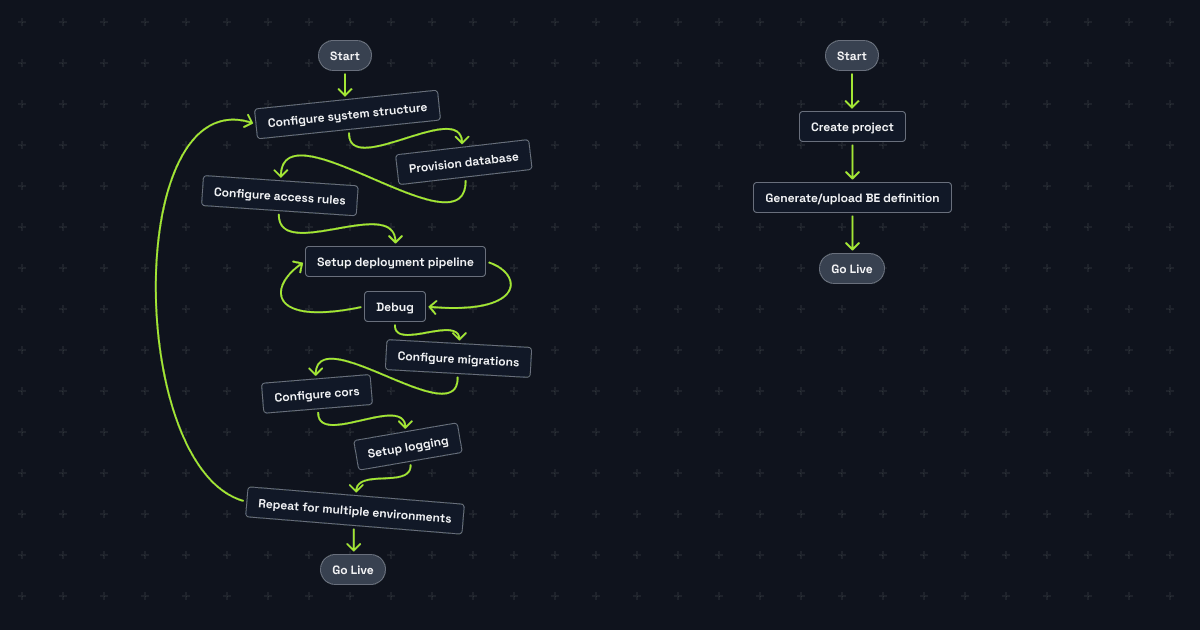
Most generated apps accumulate structure implicitly. Data models emerge because a prompt implied them. Authentication is added inconsistently. Business logic spreads across client code, handlers, and ad-hoc functions. Infrastructure decisions leak into the application layer. Workflows exist only as “whatever happens” when requests race.
None of this is unusual for a demo. The problem is that it’s not something you can govern.
As soon as you add multiple roles, approvals, background work, integrations, compliance constraints, or real uptime expectations, the backend becomes fragile. Extending it feels like a rewrite because there is no stable abstraction to extend.
For vibe-coding platforms, this is the real enterprise ceiling. Not the UI. Not generation quality. The absence of a backend strong enough to carry enterprise requirements without collapsing.
The missing move: backend standardization
Enterprise readiness is not about adding features. It’s about removing variance.
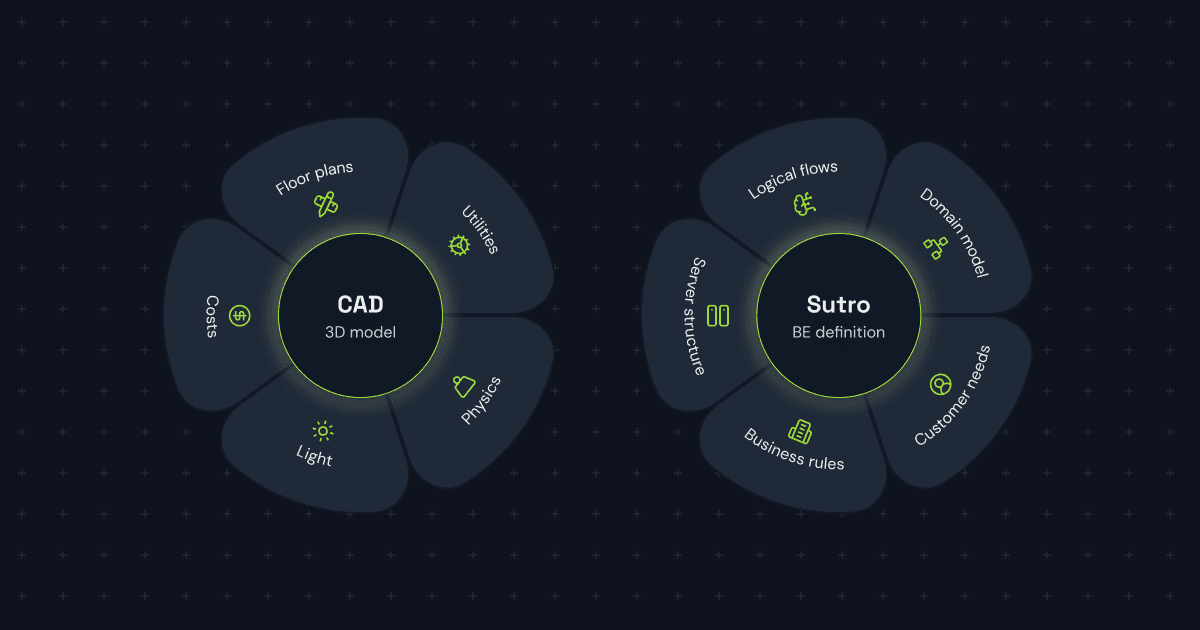
If you want your platform to produce enterprise-ready software, all generated apps need to sit on top of a standardized backend layer. One with known semantics, known boundaries, and known failure modes.
Once that exists, everything else follows naturally. Domain models become explicit. Permissions are structural rather than optional. Workflows have defined semantics instead of emerging accidentally. Auditability and observability stop being bolt-ons. Change becomes reviewable and reversible.
You’re no longer generating “some backend.” You’re generating applications on top of a backend system.
That’s the difference between AI writing code and AI producing software someone can actually run.
The quiet question enterprises always ask
There is one question enterprise buyers rarely say out loud: if this becomes critical, can our team own it?
They don’t fear AI generation. They fear unownable systems - logic embedded in prompts, unclear invariants, accidental security, and architectures that only make sense to the model that produced them.
A standardized backend layer creates a clean handoff. AI generates within a known structure. Humans can inspect, reason about, and extend it without rewriting everything.
That’s what makes procurement and IT comfortable.
The actual enterprise ceiling
The enterprise ceiling for vibe-coding platforms isn’t missing features.
It’s missing governance: no stable backend contract, no provable security model, no explicit workflow semantics, no auditability, and no controlled change.
A standardized backend layer like Sutro is the fastest way to break that ceiling, because it makes enterprise readiness a property of the platform itself - not a burden dumped onto every generated app.
That’s the difference between something that looks impressive and something someone is willing to trust.