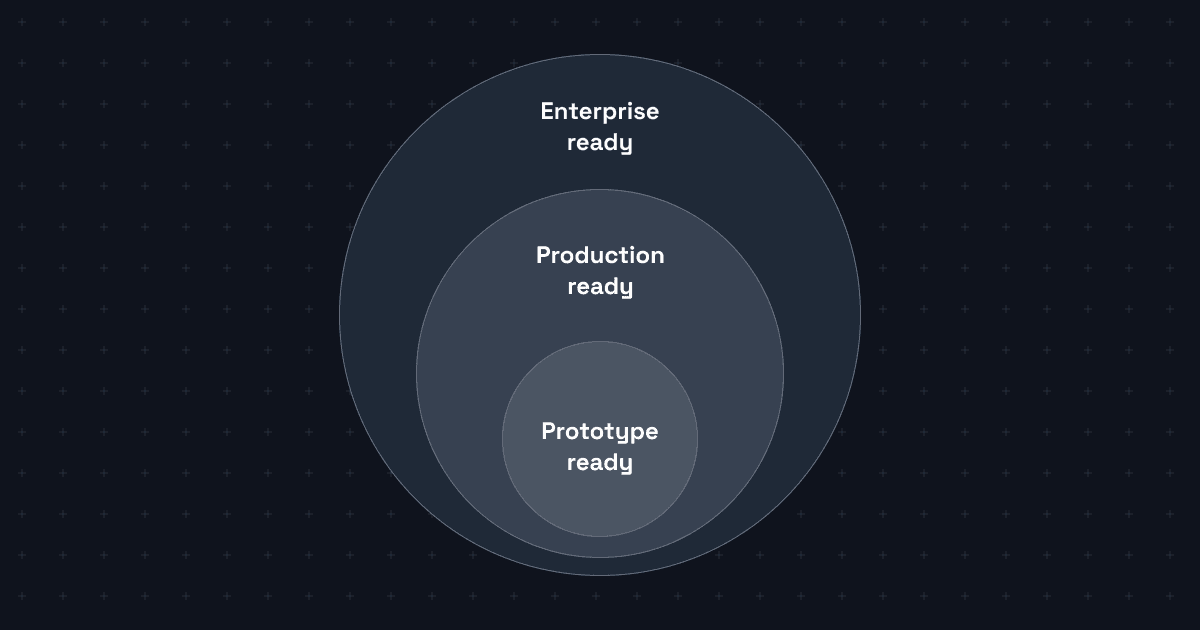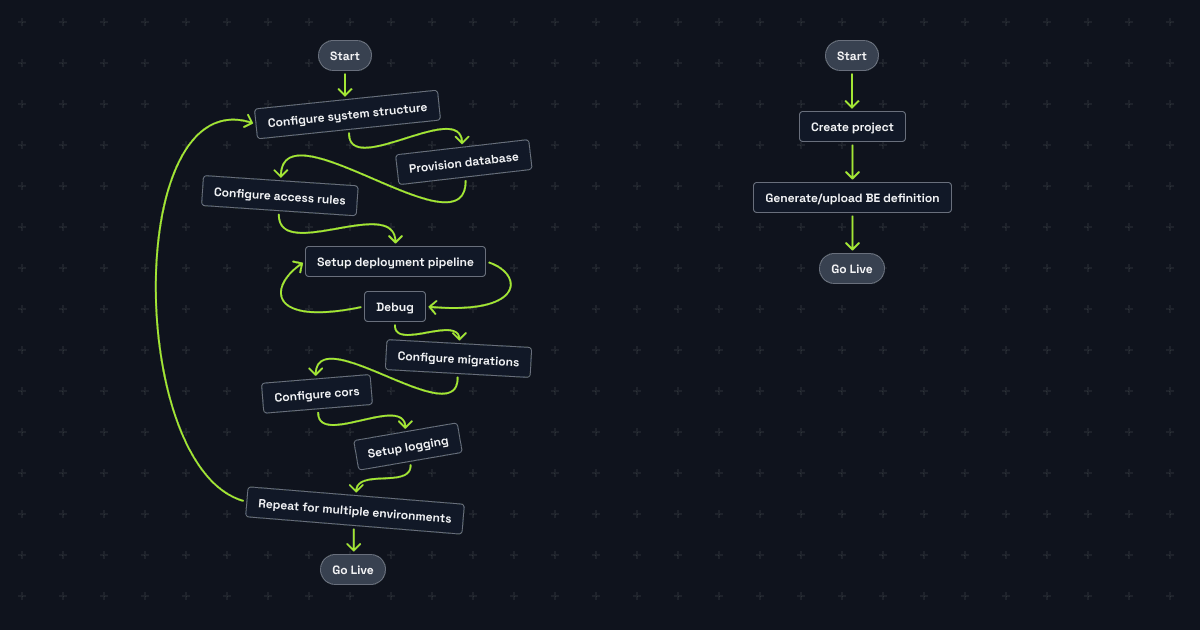
Modern full-stack tooling has made it astonishingly easy to get something working. With a few clicks, you can spin up a database, add authentication, enable real-time updates, and deploy a frontend before you have fully decided what your product even is.
For many teams, especially in the current wave of vibe-coded apps, this feels like the end of backend complexity rather than the beginning of it. From a platform perspective, this is exactly the promise you want to deliver: users feel productive immediately, and the platform stays out of their way.
For a while, that works.
But something subtle happens as products evolve, and platform teams start hearing a familiar refrain: “It worked fine at first, but now everything feels brittle.”
The hidden dimensions most teams call "scaling"
When backend problems show up, teams almost always describe them as scaling issues. More users. More traffic. Bigger servers. In practice, that’s only half the story.
Many systems fall apart long before they reach serious user numbers. Not because they cannot handle the load, but because they cannot handle the shape of the problem anymore.
What determines whether a backend architecture holds up is not just how many users it serves, but what kinds of things the system is expected to do.
From a platform standpoint, this distinction matters enormously. Two apps with the same number of users can place radically different demands on the backend depending on whether they are simple CRUD tools or systems that need background work, workflows, cross-entity invariants, or AI-driven behavior.
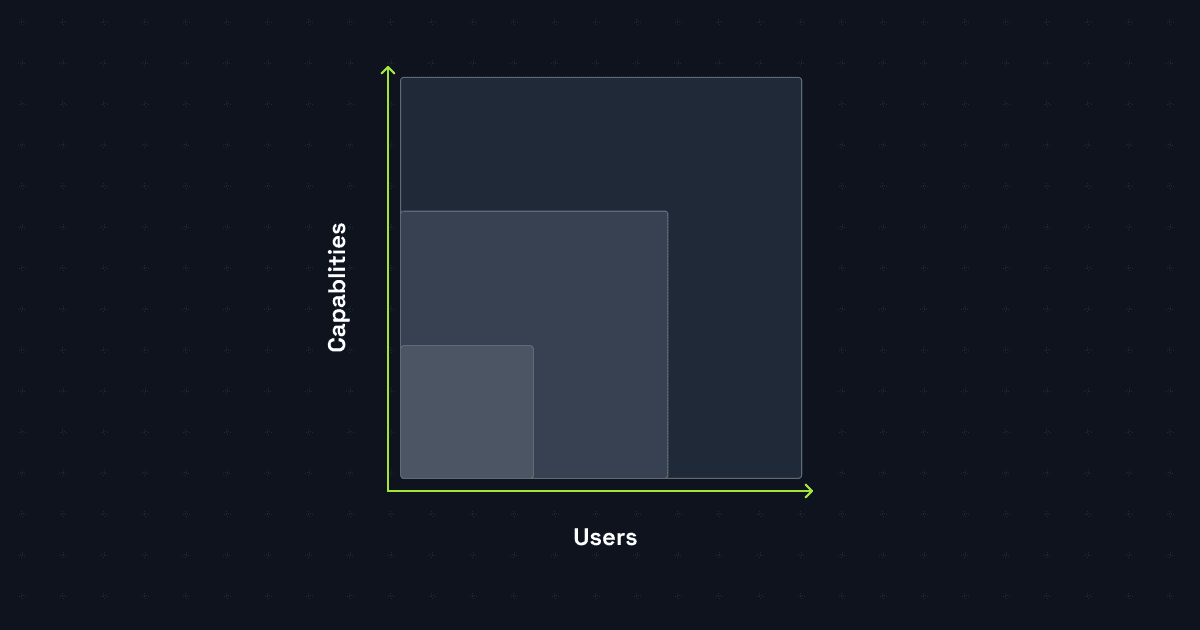
A useful way to think about this is as two independent axes:
Scale, which captures users, traffic, and operational load
Capability breadth, which captures what the system must do beyond basic request/response logic
These axes are often conflated, but they stress infrastructure in very different ways.
Where database-first backends fit and where they don't
Seen through this lens, tools like Supabase are neither “good” nor “bad” backends. They are excellent fits for specific regions of this space and poor fits for others.
Supabase shines when capability breadth is low. CRUD, authentication, and simple real-time features map cleanly to database-shaped APIs. This is why Supabase feels magical in the early stages, and why so many vibe coding platforms standardize on it as a default.
The trouble begins when apps move up the capability axis, even if they are still small in terms of users.
At that point, teams are no longer asking the backend to simply respond. They expect it to act independently, remember intent over time, coordinate multiple steps, and remain coherent when parts of the system fail. Those demands expose architectural limits that have nothing to do with raw scale.
The table below maps how backend needs typically evolve as both scale and capability increase, and why many teams hit walls much earlier than they expect.
Backend needs across scale and capability
Capabilities ↓ / Scale → | Prototype / no external users | Early Product (1–10k users) | Growing Product (10k–100k users) | Scaled / Serious (100k+ users) |
|---|---|---|---|---|
CRUD + Auth only | Supabase as full backend. Direct DB access from frontend. | Supabase still workable with RLS and light API routes. | Supabase used primarily as a database. Separate API layer appears. | Dedicated backend with API gateway, caching, managed Postgres. |
Domain logic & invariants | Minimal logic. Stored procedures or client-side checks. | API layer emerges. Validation and basic rules. | Strong domain model with explicit services. | Multi-service domain with clear ownership and contracts. |
Async work / background jobs | None or fragile hacks. Client polling. | Queues introduced. Simple workers and cron jobs. | Dedicated job systems with retries and idempotency. | Event-driven infrastructure with backpressure handling. |
Real-time & reactivity | Supabase realtime subscriptions. | Mix of realtime and polling. | Event fan-out via WebSockets or pub-sub. | Streaming architectures with events as first-class. |
Search & discovery | SQL | Postgres full-text search. | Dedicated search services. | Multi-index search with ranking and analytics. |
AI / long-running workflows | Inline external API calls. | Background AI jobs. | Workflow orchestration and state machines. | AI pipelines with tracing and cost controls. |
Observability & reliability | Console logs. | Centralized logging. | Metrics, tracing, and error budgets. | SLO-driven operations and incident response. |
Team & deployment | One developer, manual deploys. | Basic CI/CD. | Infrastructure as code and environments. | Platform team model. |
Why capability breadth hurts first
Scaling along the horizontal axis is mostly quantitative. You do the same things, just more of them. Throughput, latency, and cost become the dominant concerns.
Capability breadth is different. It is qualitative. Each step upward introduces new kinds of behavior and entirely new failure modes.
This is why many vibe-coded apps hit walls surprisingly early. Not at millions of users, but when they introduce background jobs, cross-entity invariants, async workflows, or AI features that do not fit a simple request/response model.
From the outside, it looks like the backend “stopped scaling.” From the inside, what actually happened is that the system crossed into a region it was never designed to support.
The takeaway for platform builders
Early-stage, full-stack tooling optimizes heavily for the bottom-left corner of this map: low scale, narrow capabilities, fast iteration, minimal infrastructure. That optimization is not a flaw. It is why vibe coding works.
Problems arise when that same backend model is expected to support fundamentally different kinds of behavior without changing shape.
The key distinction is that scale stresses infrastructure quantitatively, while capability breadth stresses infrastructure qualitatively. The second almost always becomes painful first.
For vibe coding platforms, this is the inflection point that matters. It is where users stop asking “how do I build this?” and start asking “why does this feel so hard now?”
At that point, the backend is no longer just responding to users. It is expected to act, remember, coordinate, and stay coherent over time. Whether your platform can support that transition determines whether it remains a place for prototypes, or becomes infrastructure for real products.