Why database-shaped APIs become a bottleneck for vibe coding platforms
November 27, 2025
5
minute read

Tomas Halgas
Founder & CEO
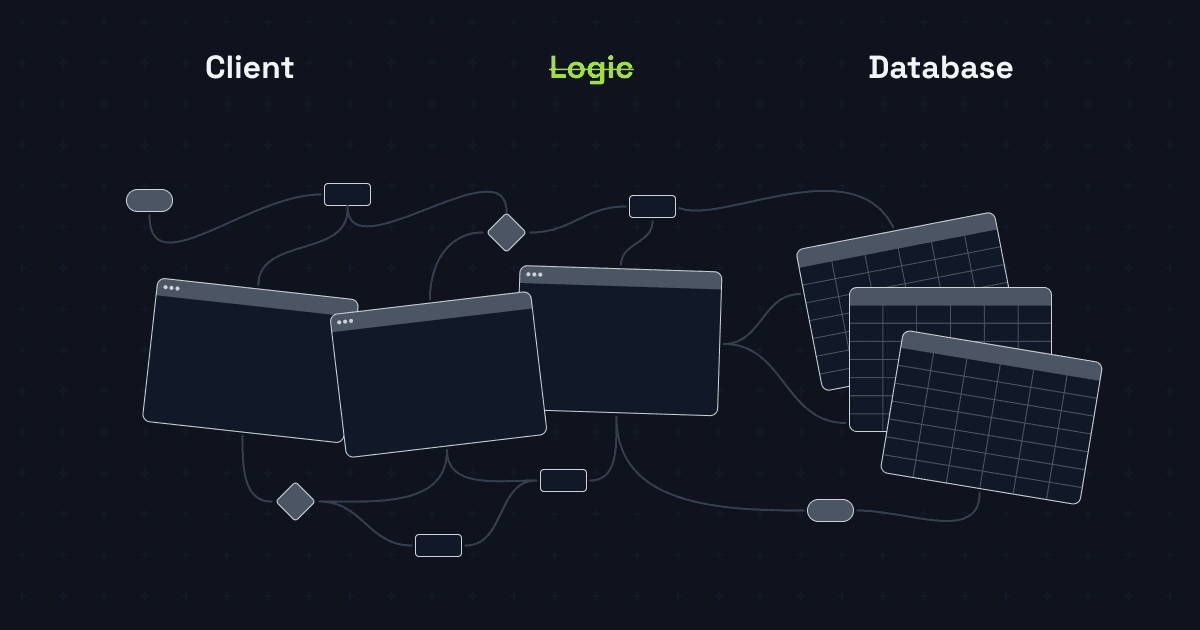
Supabase is often described as a “backend,” but architecturally it is a database with APIs generated directly from how data is stored.
This is not an accident. It is a deliberate design choice, and it explains both why Supabase is so attractive early on and why many teams eventually struggle with it. By exposing data directly, Supabase removes friction at the start. You get tables, authentication, and usable APIs almost immediately. For vibe coding platforms that want users shipping something quickly, that simplicity is compelling.
The limitation is more subtle. Supabase does not introduce a product-level model that exists independently of the database schema. In practice, this means the shape of the APIs your users consume is tightly coupled to how data is stored and optimized.
That coupling is where problems start to appear, often earlier than platform teams expect.
The missing layer: a product model separate from storage
Most real products have a conceptual model that is not identical to how data is stored. This is sometimes called a domain model, but the idea itself is simple. It is the backend’s opinion about what the product’s objects actually are.
It answers questions like what a “User” means in the product, which pieces of information belong together even if they live in different places, and which data should be derived dynamically rather than persisted forever. Most importantly, it allows the backend to change how data is stored without forcing the frontend to change how it thinks.
Supabase largely skips this layer. The frontend works with database-shaped objects rather than product-shaped ones. For early use cases, that feels efficient. Over time, it becomes constraining.
When storage shape leaks into product logic
In real products, the way data is stored is often different from the way it should be presented or reasoned about. A simple example is online status. Online status changes frequently and needs to be fresh. Many systems deliberately avoid storing it in the primary database and instead keep it in memory.
With a product-level model, this is straightforward. The backend loads the user from storage, checks online status from a fast store, and returns a single, coherent user object. The frontend does not need to know where each field came from.
With a database-shaped API, this separation disappears. If online status is not a column, it does not exist in the API. If it is added as a column, storage decisions are now being driven by API shape rather than correctness. If it lives elsewhere, the frontend is forced to fetch and merge data itself.
This is not a misuse of Supabase. It is a direct consequence of an architecture where storage and product concepts are the same thing. Over time, frontend code becomes aware of which fields are “real,” which are derived, and which live somewhere else. That knowledge does not belong in the UI, but there is nowhere else for it to go.
When the frontend becomes the domain layer
Another role of a product model is assembling meaningful objects out of related data. Things like a conversation with its participants and last message, a user with their role in an organization, or a document paired with what the current user is allowed to do.
In a system with a domain layer, these are first-class objects. The backend understands how they fit together and returns them as a unit.
With database-generated APIs, these objects often only exist implicitly. If the combination does not map cleanly to a table or a join, it does not exist at all. The frontend ends up making multiple calls, stitching data together, and encoding assumptions about relationships and permissions that really belong to the product itself.
As platforms scale, this pattern creates friction. Frontend code grows more complex, harder to reason about, and more error-prone. Bugs show up as inconsistent UI states or subtle permission issues. From the user’s perspective, it feels like instability. From the platform’s perspective, it is a growing maintenance burden.
When access rules become hard to reason about
Product-level models are also where access decisions become explicit.
Consider a simple rule: a user can see messages because they are a participant in the conversation. In a domain layer, that logic is expressed directly. The system checks participation, confirms access, and returns messages.
In a database-first system, access is typically enforced indirectly through row-level policies. The rule exists, but the reasoning behind it is implicit. It is encoded in schema relationships and policy conditions rather than expressed as product logic.
This works, but it has tradeoffs. Access rules become harder to read and reason about. Small changes to storage or relationships can have unintended effects on permissions. Frontends cannot reason about access in product terms, only in terms of what queries succeed or fail.
The issue is not that Supabase is insecure. It is that the product’s access logic has no clear, explicit home.
Why product evolution becomes risky
As products mature, their object shapes change. Fields are added or removed. Some data becomes derived rather than stored. Performance optimizations reshape how information is laid out.
With a product model, these changes are largely internal. The frontend continues to work with stable concepts even as storage evolves.
Without one, storage shape is API shape. Changing how data is stored means changing APIs, which means changing frontend code. Over time, teams become hesitant to improve data models because everything depends on them. The database schema slowly becomes the product model, not because it is ideal, but because it is difficult to change.
For vibe coding platforms, this is particularly painful. Early architectural shortcuts become long-term platform constraints, and advanced users eventually hit limits that feel arbitrary from the outside.
What this means when choosing a backend layer
A database-first backend works well when product objects map cleanly to tables, access rules are simple, and storage shape can safely leak into the frontend. It is also well-suited to products that do not expect to change much or combine data from many sources.
It becomes limiting when platforms need stable product concepts, want to evolve internals without breaking users, or need to integrate data that does not naturally live in tables, such as presence, derived counts, or activity signals.
This is why many teams eventually introduce a backend domain layer. Not because Supabase cannot scale, but because products need a place where their concepts live independently of storage.
Supabase is very good at storing data.
It is just worth being clear about what it does not provide: a product-level model that can evolve, reason, and remain stable as everything underneath it changes.